A GEP ECOTECH perspective for investors, project developers and plant operators
1. The bottom line
The screw shredder was not built for textile waste. It was built for plastics and rubber—and the textile industry borrowed it.
That borrowing made sense. It still makes sense for small, clean, single-material streams. But when a screw shredder is given the main size-reduction duty on a large textile line—with sponge, automotive interior trim and mixed fabrics in the feed—its design limits surface fast.
Our recommendation is not to reject the screw shredder. It is to move it back where it belongs: a downstream finishing step. And to hand the main duty to a machine designed for it—the GSE330 heavy-duty 3-metre single-shaft shredder.
2. Where did the screw shredder come from?
Trace the technology back and you land in plastics and rubber recycling. Manufacturer literature for screw-type shredders has always listed the same materials: plastic film, bulk bags, nylon fabric, non-wovens, polyester, rubber, tyres, EVA shoe soles. That is a plastics and rubber machine, not a textile machine.
Builders in Shandong and Guangdong were the first to scale it domestically—for plastics. When textile waste recycling took off and plants needed one more reduction step after the twin-shaft shredder, the industry reached for the machine that was already there:
Twin-shaft shredder → magnetic separation → screw shredder |
It worked often enough to be copied everywhere. But the line carries a mismatch at its centre: the main reduction duty was handed to an extrusion-and-attrition machine designed for plastics.
3. Why it was adopted—and why that was reasonable
Be fair to it. The screw shredder solved a real problem:
- Hammer mills wrapped and jammed on flexible fabric. - The screw action—hook, shear, convey, grind—moved soft material through continuously instead of tangling it. - Discharge through end slots or screens gave a controllable, relatively fine product. - Small footprint, low entry cost: ideal for a plant starting out.
All of that holds for modest volumes of clean, single-source material. It stops holding when volume rises and the feed gets mixed.
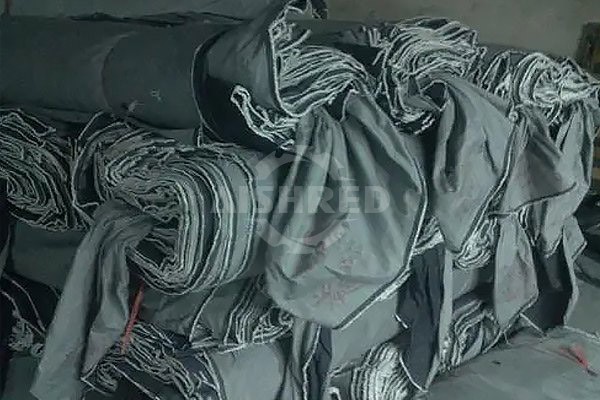
4. What operators actually report
From long-running installations:
No. | Problem | What operators report |
1 | Overheating | Body temperature rises until the machine trips; internal bolts have failed from heat. High failure rate. |
2 | Re-welding intervals | Screw cutters can be re-welded, but need repair after roughly 900–1,000 tonnes. |
3 | Cannot bite light material | Fed straight from a twin-shaft, sponge and automotive interior trim are not gripped. They accumulate in the chamber and the machine runs empty. |
4 | Broken cutters | At higher rotor speeds, common cutter steels (manganese steel, 55SiCr) break. One broken cutter stops the machine. |
5 | Metal intolerance | Any stainless steel or similar metal in the feed trips the machine immediately. |
Five symptoms. One cause.
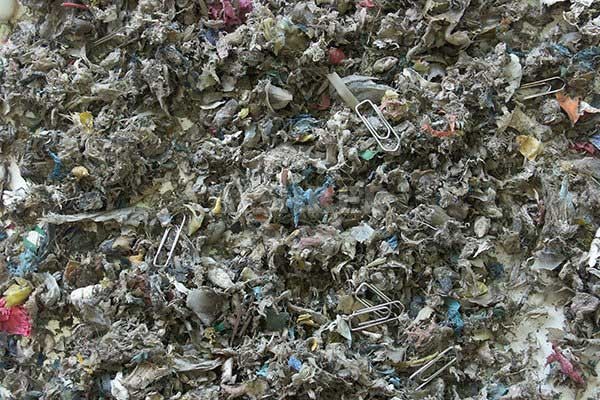
5. Root cause: extrusion and attrition vs. shear
The screw shredder works by conveying, compressing and repeatedly grinding material inside a barrel before extruding it through end slots. Three consequences follow directly:
- Long residence time and heavy friction—heat builds up. (Problem 1) - Complex spiral cutters under concentrated load; when worn, the only remedy is re-welding. (Problem 2) - Gripping depends entirely on the screw's own bite. Bulky, springy material that will not compress simply circulates. (Problem 3)
Push the speed up to chase throughput, and those spiral cutters see impact loads they were never shaped for. (Problem 4)
A heavy-duty single-shaft works differently: moving and fixed cutters shear the material, and a classifying screen discharges it the moment it reaches size. Material is not milled over and over in the chamber. Energy goes into cutting, not into heat.
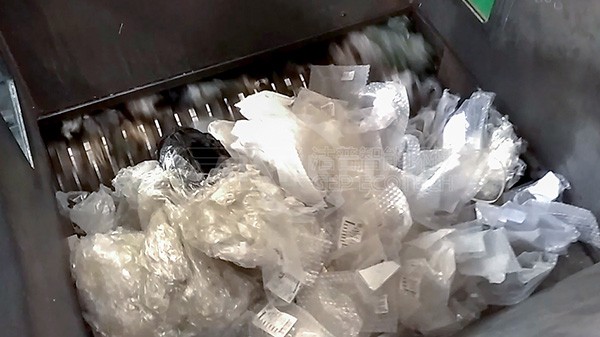
6. The GSE330 answer, point by point
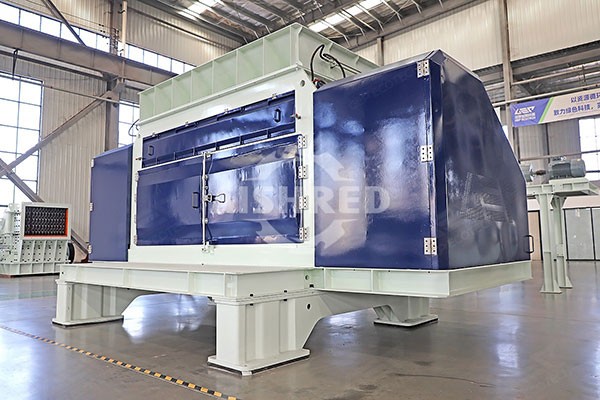
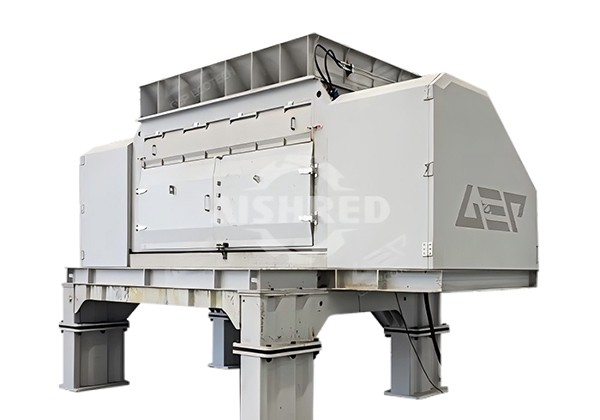
The GSE330 is GEP ECOTECH's third-generation heavy-duty single-shaft fine shredder: rotor length 120" (approx. 3 m), rotor diameter 32", cutting chamber 120" × 68", twin-motor twin-reducer drive, 400–500 kW, throughput 5–20 t/h, output 30–100 mm set by the classifying screen.
Screw shredder problem | How the GSE330 answers it |
Overheating trips | Sheared material leaves through the screen immediately—no repeated grinding in the chamber. A hydraulic ram feeds on demand instead of compressing material forward. Temperature stays controlled. |
Re-welding every 900–1,000 t | Square high-alloy cutters with four usable edges. Rotate or replace—no welding. A wear-resistant layer is applied to the cutter shaft. Maintenance is measured in hours. |
Light material not gripped | A hydraulic ram forces bulky feed—sponge, automotive trim, used clothing—into the rotor. Nothing "fails to bite". |
Broken cutters | Square cutters load evenly and the shaft is reinforced. The GI control system detects overload and auto-reverses to clear, preventing impact damage. |
Metal intolerance | In fairness, a single-shaft shredder is also not built to swallow hard metal. The difference is response: the GSE330 reverses, discharges and alarms—it does not snap a cutter and stop. GEP ECOTECH also specifies magnetic and eddy-current separation upstream to keep hard objects out. |
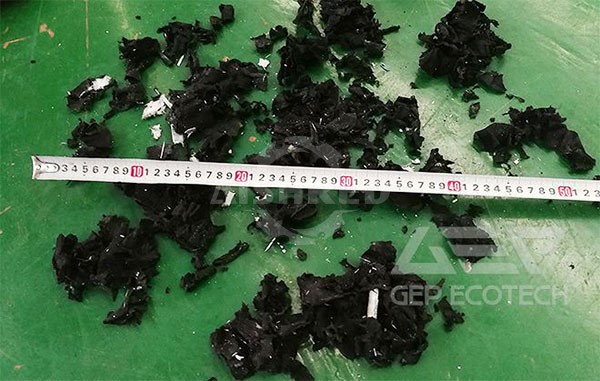
7. Head to head
Dimension | Screw shredder in textile lines | GSE330 heavy-duty 3 m single-shaft |
Technology lineage | Adapted from plastics/rubber screw shear-extrusion | Purpose-built for solid waste fine shredding |
Mechanism | Screw convey + compression + in-chamber grinding | Moving/fixed cutter shear + screen classification |
Feeding | Relies on the screw's own bite | Hydraulic ram forces feed in |
Bulky, springy material | Accumulates; machine runs empty | Gripped and fed consistently |
Chamber temperature | Heat builds up | Controlled |
Cutters and upkeep | Spiral cutters, repaired by re-welding | Square cutters, four edges, fast change |
Tramp metal | Stops the machine | Auto-reverse + upstream separation |
Output size | Fine; set by end slots / screen holes | 30–100 mm, adjustable classifying screen |
Power vs. output | Approx. 250 kW, 4–5 t/h in service (operator feedback) | 400–500 kW, 5–20 t/h |
Position in the line | Downstream finishing | Main fine shredding / size control |
One caveat worth stating plainly: the two machines do not produce the same particle size, so energy per tonne is not a fair like-for-like number. The real question is which machine holds its output, hour after hour, on your material.
8. Choose by duty, not by habit
A screw shredder still fits when:
- The material is single-source and consistent—a garment factory's own cutting waste, for example. - The feed is clean, with metal and hard objects already removed. - Volume is modest and fineness matters more than tonnes. - Budget and floor space are tight and the project is starting out.
A heavy-duty 3-metre single-shaft fits when:
- The feed is mixed: sponge, automotive interior trim, leather, woven bags—bulky or resilient fractions. - The line runs continuously and downtime is expensive. - Downstream sorting, RDF/SRF production or pelletizing needs a consistent, controllable particle size. - You must show investors, regulators or off-takers a verifiable continuous operating record.
9. The line we recommend
Take the screw shredder off the main duty. Do not simply delete it.
Textile waste → twin-shaft shredder (primary) → magnetic separation → GSE330 fine shredding (30–100 mm) → eddy current / air / optical sorting → fine grinding, pelletising or RDF forming as required |
Two things change:
1. Main reduction goes to a machine shaped for the job. The hydraulic ram solves bulky feed, the four-edge cutters solve maintenance frequency, and auto-reverse solves tramp-metal shock.
2. Fineness moves downstream. If the off-taker genuinely needs a finer product, add a dedicated finishing unit at the end—instead of asking the main machine to grind.
10. The cost that never appears in the quotation
The most expensive number in equipment selection is not the price difference. It is the downtime hours, the re-welding labour and the lost tonnes you absorb every year after start-up.
A 250 kW screw shredder running 4–5 t/h looks like a low barrier to entry. Once it needs welding every 900–1,000 tonnes, spins empty on sponge, and trips on a piece of stainless steel, the true cost per tonne climbs quietly—and keeps climbing.
The value of a heavy-duty 3-metre single-shaft is not that it is more aggressive. It is that it removes, at design level, the three things large textile lines fear most: material that will not feed, stoppages that never end, and maintenance that never stops.
GEP ECOTECH designs and builds single machines and complete lines—twin-shaft primary shredding, magnetic separation, heavy-duty single-shaft fine shredding, sorting and forming—backed by the GI intelligent monitoring system and full lifecycle service.
Bring us your material. We will run it, and let the test data make the decision.
Contact James:+86 151 3620 6913