Against the backdrop of accelerating urbanization and infrastructure renewal, the generation of construction waste has surged dramatically, with reinforced concrete components accounting for a significant proportion. Traditional landfill disposal methods not only occupy land and pollute the environment but also represent a substantial waste of the resources embedded within. Therefore, the systematic and high-value recycling of reinforced concrete construction waste has become a key driver for promoting green, low-carbon transformation in the construction industry and the development of a circular economy. This article aims to systematically analyze its recycling processes, technical solutions, and comprehensive value.
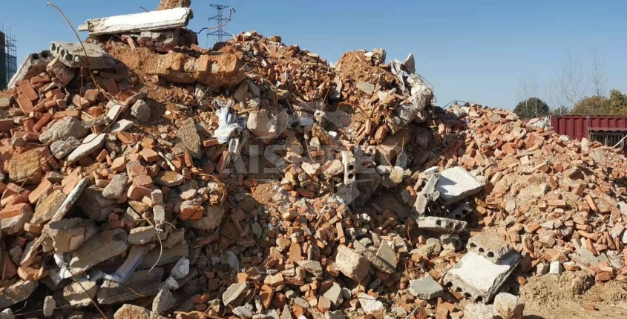
Systematic Recycling Process Path: From Mixed Waste to Classified Resources
Preprocessing and Primary Crushing
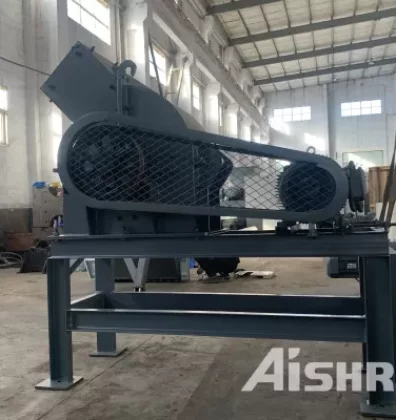
The large chunks of reinforced concrete after demolition undergo preliminary sorting (removing obvious impurities such as wood and plastic) before being fed into a jaw crusher for primary crushing. The goal at this stage is to reduce the material particle size to below 300 mm, while the crushing process—through compression and shearing—initially disrupts the bond between concrete and steel, exposing, twisting, or separating some reinforcement bars. The primary output consists of a coarse mixture of crushed concrete and steel.
Key Separation and Intermediate Processing
This stage is the core of the entire process, aiming to achieve efficient and high-purity separation of steel bars and concrete.
Magnetic separation: Mixed coarse crushed materials are transported via conveyor belts and pass through high-intensity permanent or electromagnetic iron removal devices. The strong magnetic force effectively adsorbs and separates over 90% of ferromagnetic materials such as steel bars and iron wires. The recovered steel bars are directly baled and sent to steel mills as high-quality raw materials for steel production.
Manual/Mechanical Assisted Stripping: For larger concrete blocks that remain partially attached and still embedded with rebar, auxiliary disintegration methods such as hydraulic grippers and manual gas cutting are employed to ensure maximum recovery of metal resources.
Secondary Crushing and Shaping: After separating the rebar, the concrete chunks enter an impact crusher or cone crusher for medium and fine crushing. The impact crushing characteristics of the impact crusher help generate more cubical particles and further remove the adhered cement paste, improving the aggregate particle shape.
Fine Classification and Purification
The crushed material is strictly graded by particle size through a multi-layer vibrating screen (such as three or four layers)
Recycled coarse aggregate: Typically with a particle size of 5-25mm or 5-31.5mm, it serves as the primary product for replacing natural crushed stone.
Recycled fine aggregate: particles with a size between 0.15mm and 5mm, containing a large amount of cement stone powder.
Fine powder: particle size less than 0.15mm, primarily composed of cement stone and stone powder.
During this process, a wind shifter is often employed to remove lightweight impurities (such as plastic and paper). For high-quality application scenarios, additional equipment such as washing or scrubbing machines may be added to reduce the content of mud powder and chloride ions in the aggregates, thereby enhancing the product's added value.
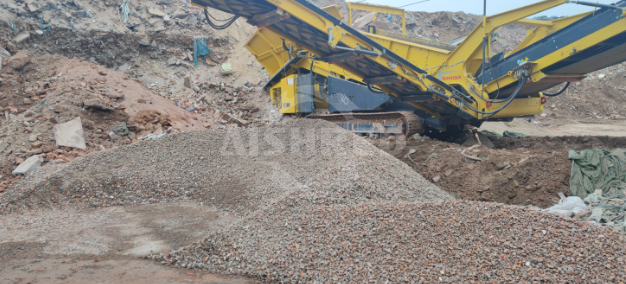
Core Resource Recycling Strategy: Tiered Utilization
Based on the performance characteristics of recycled products, a tiered utilization plan can be formulated to achieve the optimal balance between economic and environmental benefits.
High-Value Recycling Direction: High-quality recycled coarse aggregate, after enhanced processing (such as particle shaping and chemical reinforcement) and stringent quality control, can be proportioned scientifically (typically ≤30%) to produce recycled structural concrete grades C25-C40 for applications like non-load-bearing walls, road pavements, and small precast components.
Civil Engineering Grade Application (Bulk Disposal Method): This is currently the largest disposal route. Recycled aggregates can be directly used as materials for road base layers or subbase layers, or as backfill materials for roadbeds and foundation pits. Their performance fully meets engineering requirements, and they offer significant cost advantages.
Product-Grade Application (Resource Recycling Closed-Loop): Mix recycled aggregates with cement, admixtures, etc., to produce products such as recycled permeable bricks, curbs, grass-embedded bricks, and concrete blocks.
GEP ECOTECH Supporting Technology Innovation and Management Solutions
Mobile Crushing Plant Solution: For demolition projects that are scattered or difficult to transport, an onboard mobile crushing and screening production line is employed to achieve on-site processing and utilization, significantly reducing transportation costs and secondary pollution.
End-to-End Digital Management Solution: By integrating IoT technology, the system enables online monitoring and data tracing of incoming materials, production processes, and product quality, ensuring refined production and stable, controllable product quality.
Concrete construction waste recycling is a systematic project integrating crushing and sorting technology, materials science, and environmental protection policies. GEP ECOTECH has been committed to providing modern solutions and equipment for construction waste recycling professionals through advanced processes, promoting green development in the construction industry. It transforms construction waste into high-quality recycled steel and aggregates, reintegrating them into the economic cycle to achieve a circular economy and sustainable development in the construction sector.