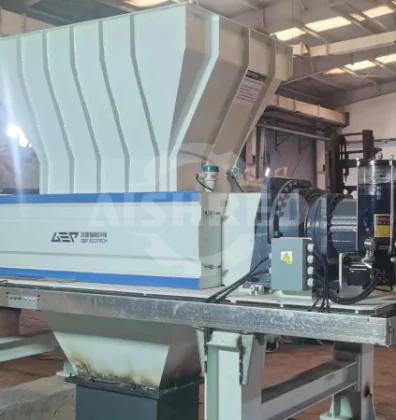
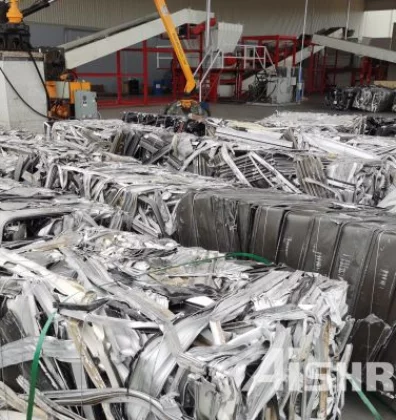
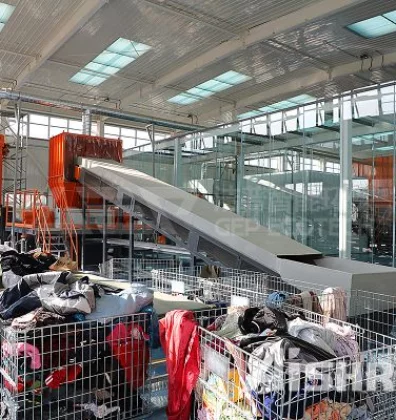
The generation of construction waste increases year by year. How to efficiently dispose of it and achieve resource utilization has become a focal point in the industry. GEP ECOTECH, targeting the characteristics of construction waste, provides a complete process flow from raw material pretreatment to finished aggregate production. The following is a brief introduction to the process flow and core equipment of this treatment line.
Process Flow: Three-Stage Refined Treatment
This treatment line divides the disposal of construction waste into three stages: raw material pretreatment, crushing/screening/impurity removal, and finished product output. Each stage is closely linked, aiming to improve aggregate purity and recovery efficiency.
Raw Material Storage and Pretreatment
Construction waste raw materials are transported to the plant site and stockpiled in the raw material area. In the pretreatment stage, large bulky impurities such as wood, plastics, non-ferrous metals, and cables are preliminarily removed through manual sorting or mechanical means (e.g., hydraulic breaking hammer). Large reinforced concrete blocks are broken down to a size that can enter the crusher, thereby preventing clogging or damage to subsequent equipment.
Jaw Crusher Primary Crushing and Primary Iron Removal
The pretreated material is fed by a loader or excavator into a vibrating feeder. During the feeding process, part of the soil and fines pass through as undersize material into a flip-flop screen for further separation, while the oversize material is evenly conveyed to the jaw crusher. The jaw crusher performs primary crushing on the material, breaking large concrete, bricks, stones, etc., into smaller particle sizes. The discharge, combined with the undersize from the flip-flop screen, is conveyed by belt conveyor and passes through an iron remover to absorb magnetic metals such as rebar and iron pieces. The flip-flop screen further separates 0-10mm soil as undersize output at this stage, while the oversize material returns to combine with the jaw crusher discharge for the next separation process.
Air Separation and Manual Sorting
The jaw crusher discharge and the flip-flop screen oversize enter the air separator. Under the action of a controlled airflow, light materials such as plastics and glass are separated and discharged, while heavy materials enter the manual sorting belt. The manual sorting platform is used to recover materials with reuse value (e.g., specific plastics, metals, etc.). The sorted material is fed into an impact crusher for secondary fine crushing.
Impact Crusher Fine Crushing and Secondary Iron Removal
The impact crusher performs secondary fine crushing on the material, making the particle shape more regular and the particle size more uniform. After fine crushing, the separation of stone materials and iron impurities becomes more thorough. At this point, a magnetic separator is used again for iron removal to ensure aggregate purity.
Finished Aggregate Particle Size Separation and Light Impurity Removal
After impact crushing, the material enters the finished product screen, which separates aggregate products of different particle sizes:
- <5mm: Fine powder (soil, ash sand)
- 5-10mm: Fine aggregate
- 10-31.5mm: Medium-sized aggregate
- 31.5mm: Returned via return belt to the impact crusher for re-crushing.
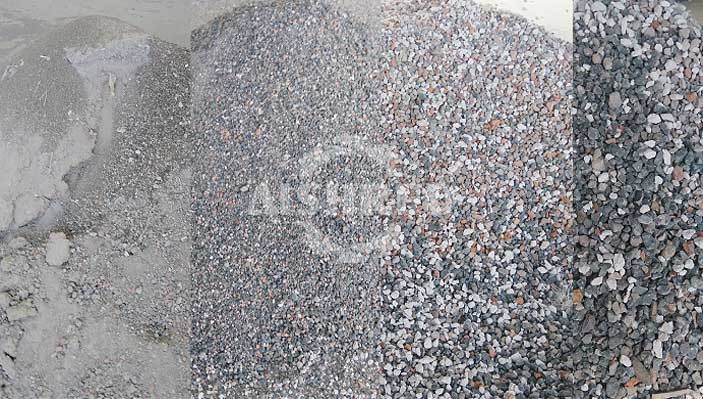
Subsequently, a light material processor is used to separate residual light impurities such as wood chips, paper pieces, and plastic flakes from the aggregate, further improving finished product purity. The final clean aggregates are stockpiled separately according to specifications and can be used for brick making, road base layers, or recycled concrete aggregates.
Environmental Protection: Dust Removal and Dust Suppression
The treatment line is equipped with a dry dust collection system and a high-pressure wet dust suppression system. The dry dust collection system connects to a baghouse dust collector via pipelines at dust collection points, purifying dust-laden gas and recovering valuable dust. The high-pressure dust suppression system uses water mist spraying to capture dust in the air, and can also produce wet sand. The combination of both effectively controls workshop fugitive dust.
Introduction to Core Equipment
This treatment line integrates multiple types of specialized equipment. The performance of each equipment item is as follows:
Vibrating Feeder: Adopting a double eccentric shaft exciter. The trough performs linear vibration along the inclined direction to achieve continuous feeding. The bottom of the trough is equipped with grizzly bars or screen plates, which can pre-separate fines such as soil.
Jaw Crusher: Specifically designed for crushing hard materials like bricks, tiles, and stones in construction waste. Adopting a symmetrical V-shaped crushing chamber and an assembled frame, featuring a large crushing ratio and not prone to clogging, equipped with a centralized lubrication system and a hydraulic discharge port adjustment device for easy maintenance.
Impact Crusher: Suitable for medium and fine crushing of concrete, asphalt, and bricks, using impact energy to crush materials, adopting a heavy-duty rotor, standardized liners, and a unique blow bar locking mechanism, equipped with an over-iron protection device to prevent equipment jamming.
Flip-Flow Screen: Using a combination of screen mesh and punch plates (or rod deck). Suitable for uniform feeding of large materials before the crusher. The gap of the rod deck is adjustable, allowing separation of soil and fine materials during feeding. Simple structure and impact-resistant.
Wind Sifter: Using air as the separation medium, utilizing positive and negative pressure airflow to separate light materials from heavy materials. Both the fan and the feeding conveyor adopt variable frequency control, allowing adjustment of air volume and speed according to material characteristics.
Magnetic Separator (Iron Remover): Using a permanent magnetic core, matched with a belt conveyor, automatically throwing ferromagnetic materials into an iron collection box, achieving continuous automatic iron removal.
Manual Sorting Platform: Used for material classification and quality control, improving the purity of recovered materials.
Finished Product Screen: Adopting circular motion excitation method, with small amplitude, high frequency, and large inclination angle, providing high processing capacity. Rubber vibration isolation springs reduce noise.
Light Material Separator: Separating light impurities from the mixed material through uniform material spreading and air volume control.
Belt Conveyor: Friction-driven, it can transport horizontally or on an incline. The belt is wear-resistant, corrosion-resistant, and impact-resistant. Optional dust cover can be connected to the dust collection system.
Pulse Bag Type Dust Collection System: Using porous filter bags to filter dust-laden gas, pulse jet automatic cleaning of dust. Collected dust can be recycled.
High-Pressure Dust Suppression System: Setting up spray nozzles at dust generation points, capturing dust through water mist, with lower investment cost and wide applicability.
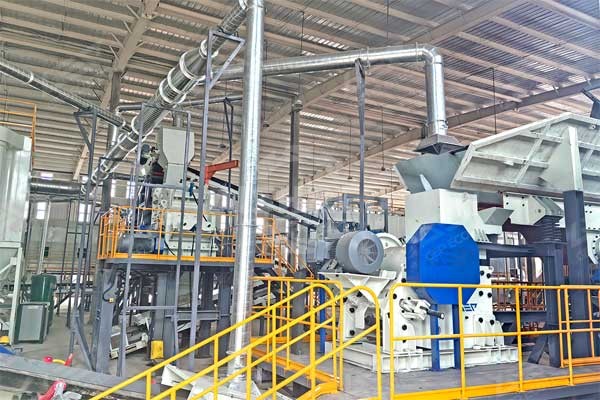
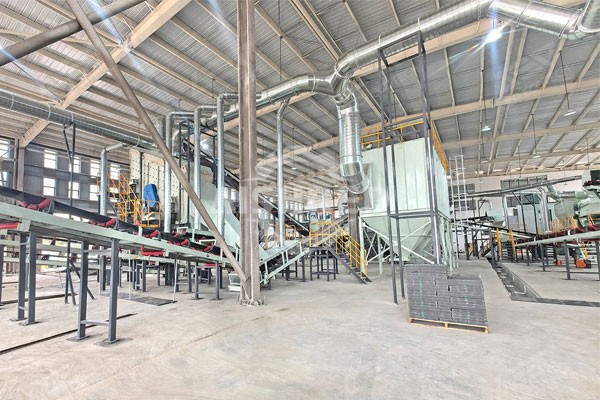
GEP ECOTECH's construction waste treatment line, through combined processes of primary crushing, fine crushing, multi-stage screening, air separation, magnetic separation, and manual sorting, achieves efficient reduction and resource utilization of construction waste, while also addressing environmental dust control requirements. It provides a reference technical solution for construction waste treatment projects. If you currently have procurement needs for a related production line, please feel free to contact us.